Who Can Participate
High school students (or equivalent secondary-school-level) worldwide with a passion for research and innovation are invited to participate. Projects may be submitted individually or by teams of up to three students. All submissions must represent original, student-driven work conducted independently or with appropriate academic guidance. Reasonable support from teachers or mentors is permitted and should be properly acknowledged in the project materials.
Project Categories
We welcome submissions across all three categories: Life & Health Sciences, Physical Sciences & Environment, and Engineering, Computer Science & AI. Projects may be experimental, theoretical, computational, or design-based, and should follow a detailed, well-structured, and logical research or engineering process.
🧬 Life & Health Sciences: Biology, medicine, neuroscience, physiology, microbiology, public health, epidemiology, and related biomedical research
💻 Engineering, Computer Science & AI and Data related Sciences: Engineering design, computer science, artificial intelligence, data science, and computational modeling
⚛️ Physical Sciences & Environment: Physics, chemistry, environmental science, materials science, and studies of natural systems and sustainability
Participants are responsible for selecting the most appropriate category for their work. All submissions must comply with competition rules, safety standards, and ethical requirements. Incomplete submissions may not be accepted.
Event Schedule
The ISRIF Fair features a full-day schedule that mirrors a professional academic conference. Activities include poster presentations, judging sessions, podium presentations for selected finalists, networking opportunities, and an awards ceremony.
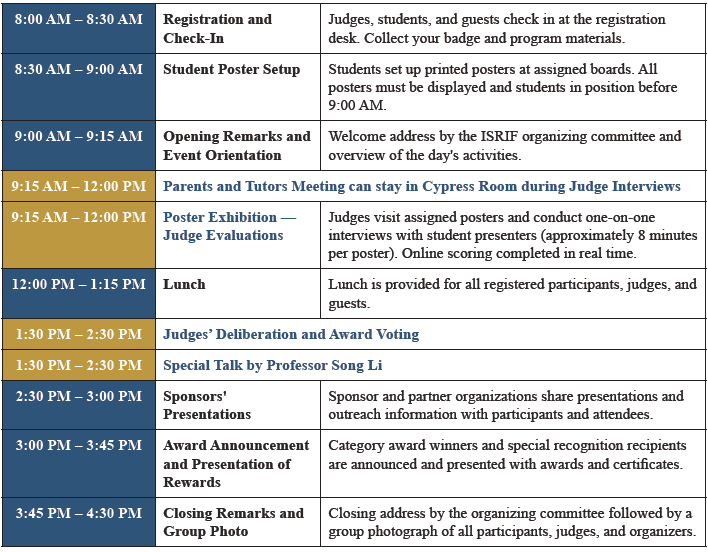
🧪Poster Presentation — Primary Judging Round
Each project is presented as a printed scientific poster displayed on-site. Students must be available for one-on-one or small-panel judge interviews (typically 5–10 minutes per visit). The poster session serves as the core evaluation stage and determines which projects advance to the finalist round.
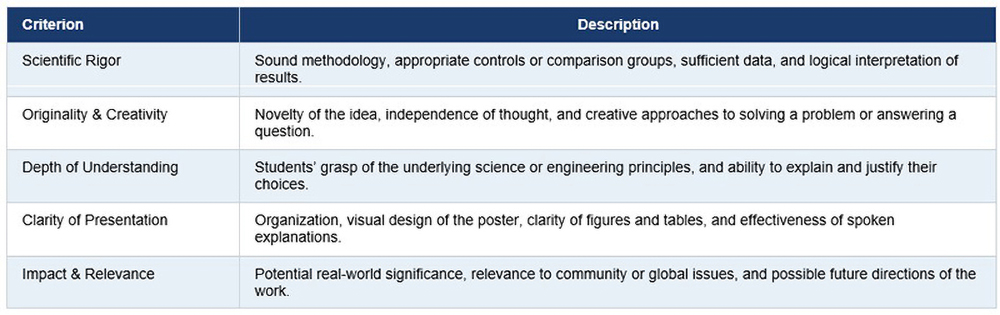
Judges evaluate:
- Clarity and logical structure of the presentation
- Ability to communicate key ideas to a broad scientific audience
- Confidence in responding to questions and defending the work